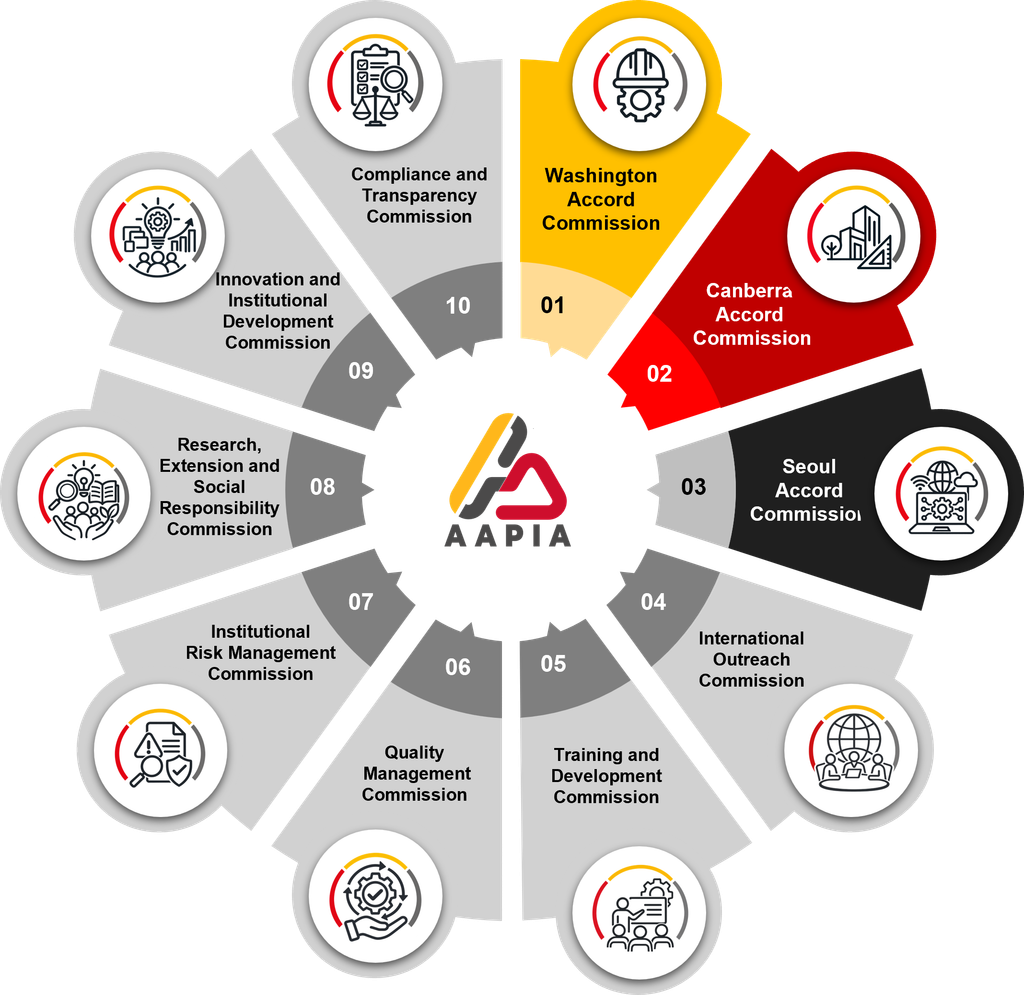
The AAPIA Specialized Commissions are technical and strategic advisory bodies that address specific areas related to the Agency’s development and consolidation. Their purpose is to provide specialized expertise, analysis, and technical guidance to support decision-making and the continuous development of accreditation processes.
Their establishment represents an institutional strength, bringing together academic, professional, and technical expertise to address strategic matters, anticipate emerging challenges, and ensure that the Agency’s activities remain aligned with good practices and national and international quality assurance frameworks.
Each Commission is composed of at least one member of the AAPIA Accreditation Council and/or Technical Committees, one Agency administrative representative, and additional participants as required according to the nature and scope of the Commission.
Collectively, this structure promotes specialized, coordinated, and sustainable management, consistent with AAPIA’s responsibilities and its ongoing institutional development.
Commissions
Objetive
Strengthen the ongoing fulfillment of the commitments and requirements of the Washington Accord, ensuring that the AAPIA–CFIA Engineering Accreditation Model remains aligned with and continuously updated in accordance with international quality standards.
Function
Monitor compliance with the requirements arising from full signatory status under the Washington Accord, promoting the continuous updating of accreditation criteria, procedures, and instruments, while strengthening the substantial equivalence of accredited Engineering programs.
Focus
Quality, Substantial Equivalence, and International Recognition
Guide Engineering accreditation processes toward the sustained application of international standards of quality and comparability, strengthening the substantial equivalence of engineering education, the recognition of accredited programs, and the international mobility and professional opportunities of their graduates.
Objetive
Strengthen the alignment of the AAPIA Architecture Accreditation Model with the international frameworks of the Canberra Accord, promoting the quality, comparability, and substantial equivalence of architectural education.
Function
Monitor the implementation and consolidation of the Architecture Accreditation Model, promoting its alignment with international principles, criteria, and good practices, while strengthening AAPIA’s pathway toward membership in the Canberra Accord.
Focus
Quality, Substantial Equivalence, and International Recognition
Guide the development of the Architecture Accreditation Model toward international standards of quality and substantial equivalence, strengthening the comparability of architectural education and the international recognition and visibility of programs accredited by AAPIA.
Objetive
Strengthen AAPIA’s alignment with the international frameworks of the Seoul Accord, developing the capabilities required for the evaluation and accreditation of Computing and Information Technology programs.
Function
Monitor the criteria, standards, and good practices of the Seoul Accord, promoting their analysis and progressive integration into AAPIA’s processes, while strengthening the Agency’s technical and methodological capabilities for accreditation in these disciplinary areas.
Focus
International Alignment, Quality, and Disciplinary Capacity Building
Guide the development of accreditation processes in Computing and Information Technology toward international quality frameworks, promoting the comparability of academic programs and the progressive consolidation of AAPIA’s accreditation capabilities in these fields.
Objetive
Strengthen AAPIA’s national and international engagement by promoting cooperation, the exchange of good practices, and active participation in networks and organizations related to quality assurance in higher education.
Function
Promote and monitor partnerships, agreements, and cooperation mechanisms with accreditation agencies, networks, universities, and professional organizations, strengthening institutional capabilities, supporting the continuous development of accreditation models, and enhancing AAPIA’s international presence and positioning.
Focus
Cooperation, Internationalization, and Quality Assurance
Guide institutional engagement toward the exchange of knowledge, good practices, and international benchmarks, strengthening the quality of accreditation processes, continuous improvement, and AAPIA’s participation within national, regional, and international quality assurance networks.
Objetive
Strengthen the technical and professional capabilities of Peer Evaluators and other stakeholders involved in accreditation processes through continuous training and professional development, ensuring the rigorous and consistent application of the AAPIA Accreditation Model.
Function
Plan and deliver training, capacity-building, and professional development activities focused on the understanding and application of accreditation criteria, procedures, and instruments, strengthening the competencies required for objective, transparent, and evidence-based evaluation.
Focus
Capacity Building, Professional Development, and Continuous Learning
Promote a culture of lifelong learning and continuous improvement, strengthening the knowledge, competencies, and practices of those involved in accreditation processes, in accordance with AAPIA’s principles of quality, objectivity, transparency, and technical rigor.
Objetive
Strengthen AAPIA’s internal quality management system, ensuring the effectiveness, consistency, and continuous improvement of its institutional and accreditation processes.
Function
Monitor the performance and continuous improvement of the Agency’s processes through the assessment of indicators, systematic review of procedures and results, and identification of opportunities and improvement actions that enhance the quality and reliability of its management.
Focus
Quality Assurance and Institutional Continuous Improvement
Promote a culture of self-evaluation, monitoring, and continuous improvement aimed at strengthening the efficiency, transparency, technical rigor, and consistency of AAPIA’s processes, in alignment with its quality policies and recognized good practices in accreditation.
Objetive
Strengthen AAPIA’s comprehensive risk management framework through the identification, assessment, and preventive treatment of situations that could affect the quality, independence, continuity, and reliability of its institutional and accreditation processes.
Function
Identify, analyze, and monitor the Agency’s strategic, operational, regulatory, and reputational risks, establishing preventive measures, control mechanisms, and contingency actions that support the continuity and resilience of its operations.
Focus
Risk Management, Governance, and Institutional Sustainability
Promote a preventive, systematic, and accountable approach to risk management, aimed at strengthening AAPIA’s response capacity, transparency, independence, and institutional continuity, in alignment with its quality principles and recognized good practices in accreditation.
Objetive
Strengthen the integration of research, innovation, community engagement, and sustainability as key components of quality and relevance within AAPIA’s accreditation processes.
Function
Promote the integration and evaluation of criteria and indicators related to research, innovation, engagement with society, and sustainable development, ensuring that accreditation processes assess their contribution to education, continuous improvement, and the relevance of academic programs.
Focus
Research, Innovation, Engagement, and Sustainable Development
Guide these areas toward strengthening academic quality and relevance by promoting the generation and transfer of knowledge, engagement with society, and the cross-cutting integration of sustainability within the programs evaluated.
Objetive
Strengthen AAPIA’s integrity, ethics, and transparency, ensuring that its activities and accreditation processes are conducted with independence, impartiality, objectivity, and accountability.
Function
Promote and monitor compliance with the Agency’s ethical principles, policies, and standards of conduct, strengthening transparency, confidentiality, conflict-of-interest prevention, and independent decision-making throughout evaluation and accreditation processes.
Focus
Integrity, Ethics, Independence, and Institutional Trust
Promote an institutional culture grounded in integrity, transparency, and accountability that safeguards the independence of decision-making, prevents conflicts of interest, and strengthens the credibility of and trust in AAPIA’s accreditation processes.